
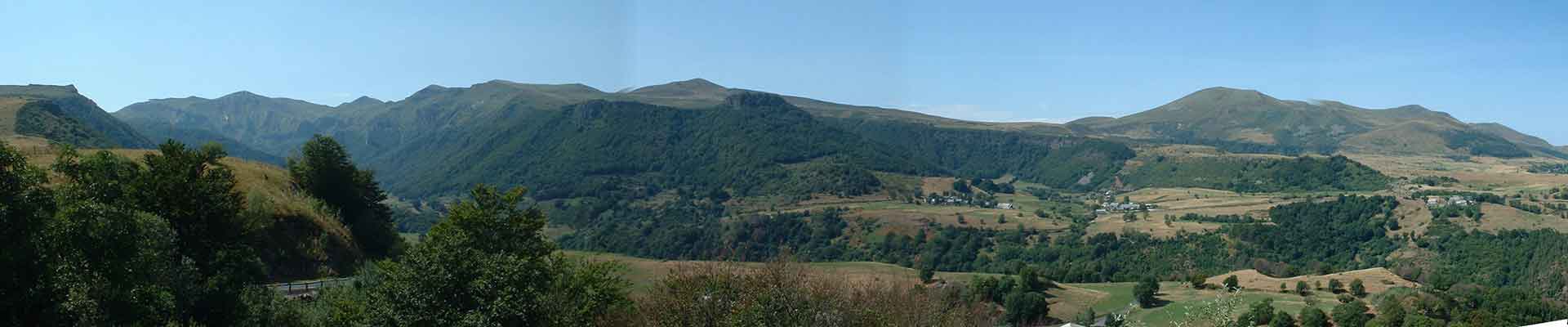
The villages around the campsite in Auvergne
16 towns to discover in the Sancy massif
Besse and Super-besse
Besse, a historic town
Super-Besse is an open-air leisure park offering a wide range of activities for all the family.
This commune combines different styles: the medieval and Renaissance town of Besse is just a stone's throw from the winter and summer resorts of Super-Besse and Lac Pavin (a must-see). From Lac Pavin you can hike to Puy Montchal and the sublime viewpoint of the lake.
What's on : the medieval and Renaissance architecture of Besse (fountains, cobbled streets lined with stalls, lava stone buildings, etc.), Lake Pavin, the Vaucoux, Chiloza and giant's waterfalls, the source of the Gayon fountain, the Puy de la Perdrix (superb panorama), the Vassivière chapel and the medieval garden.
Chambon sur Lac
Tourist centre on the shores of Lac Chambon at the foot of the Chaudefour valley
With its lake, the Chaudefour Nature Reserve, Chambon-sur-Lac combines the pleasures of water with the leisure activities of the mountains: hiking, mountain biking, swimming, canoeing, pedal boating...
What's on : Lac Chambon, the Chaudefour national nature reserve (Dent de la rancune and Crête de Coq, the St Anne spring, protected flora and fauna), the Dent du Marais (legend of the Pucelle leap), the baptistery and the church.
Chastreix
Authentic village and Chastreix Sancy resort at the gateway to the nature reserve
Situated on the western slopes of the Sancy, Chastreix curves around its Gothic church, surrounded by the summer pastures of Mont Dore.
The village offers you the chance to discover its livestock farming, the guided production of Saint-Nectaire cheese and the Chastreix National Nature Reserve...
Hiking or horse-riding, with a visit to the Salt Fountain. In winter, cross-country skiing and downhill skiing are also available.
What's on : the 13th-century Gothic church, the Chastreix Sancy national nature reserve and its breathtaking scenery, the Roc de Courlande and the 3 virgins (a place of pilgrimage), the Sancy peaks and the Essarts waterfall.
Compains
Village on the borders of the Massif du Sancy and the Cézallier. The landscape is shaped by vast basalt plateaux dotted with lakes and peat bogs. The village also boasts an exceptional landscape: the Hameau de Brion. This site owes its fame to its fairground, which is home to several burons and has been the site of traditional livestock fairs since the 17th century.
What's on : the Brion agricultural fairs, the Montcineyre lake, the Bordes lake nature reserve, the listed 12th-century church
New church in Entraigues
This village "between the waters" has no fewer than 5 lakes on its territory, and with 2 waterfalls nearby, it offers a wealth of natural beauty that awaits you in this unspoilt countryside. Numerous hiking trails. In winter, 40 km of cross-country ski trails are maintained in the area. The village, grouped around the Romanesque church, boasts a fine blend of slate and shale roofs. Saint-Nectaire cheese is on show at the Maison des Fromages, housed in an old farmhouse.
What's on : the Church of St Austremoine and the sanctuary of the Fontaine Sainte, the lakes of Esclauze, Landie, Entraigues and Bois de Chaux, the Auvergne cheese house.
Espinchal
This small mountain village is criss-crossed by the GR30 hiking trail linking the Monts du Cantal to the Massif du Sancy. Offering superb scenery, this village is a recommended stop-off point for lovers of wide open spaces.
What's on : the Moulin waterfall in the village.
La Bourboule
Surprising station along the Dordogne
A spa and health resort at an altitude of 850 m.
On the banks of the Dordogne. It boasts a superb Fenestre park with plenty of games for children. Lovely walks on the Charlanne plateau (1050 m)
What's on : Belle Epoque architecture (numerous palaces, majestic buildings) Parc Fenestre (12-hectare landscape park: numerous activities for children, lunch area, etc.) Roche des Fées (panoramic view of the resort) Roche Vendeix, the Charlannes plateau (hiking trails) the Dordogne spanned by 12 bridges, the church, etc.
Saint Victor la Rivière
A rural community with nine hamlets.
What's on : the rural heritage of the surrounding area, and the puy de Bessol for its panoramic view of the Massif du Sancy.
Valbeleix
A farming village in the heart of the pastures. This village welcomes nature lovers in a setting of greenery, pastures and mountain pastures, ideal for a change of scenery.
What's on : the superb wild landscapes.
Le Mont Dore
Large mountain village, popular with tourists in summer and winter Renowned for its spa (the Grands thermes du Mont Dore)
(asthma, respiratory tract and rheumatism), but also for its ski resort and the climb to Puy de Sancy (1885m).
What's on : The Puy de Sancy (highest bridge in the Massif Central, cable car access), the Pic du Cappucin (hiking trails, funicular railway access classified as a Historic Monument), the Grande Cascade, the Queureuilh and Rossignolet waterfalls, the Lac de Guéry, the Belle Epoque architecture, the thermal baths (partly classified as a Historic Monument), the church, the sources of the Dordogne (classified as a biosphere reserve by UNESCO in July 2012), the town centre with its many shops and pedestrian streets.
Murat-le-Quaire
A mountain village with a rural memory
This authentic mountain village, with its lauze-roofed houses, is an invitation to take a stroll.
The Maison de la Toinette and the Grange de Julien, the Jonquille farmers' market and the panoramic view from the old castle.
The Banne d'Ordanche site offers panoramic views (orientation table).
What's on : the Banne d'Ordanche (1515m, orientation table: 360° view), the Puy Gros (view of the Dordogne valley, the Sancy) the Pré Cohadon lake; rural architecture: the town hall, the restored bread oven, the lauze (volcanic stone) roofs.
Murol
Medieval village in Auvergne, between castle and lake
This charming historic village, at the foot of the ancient Tartaret volcano, boasts a lively medieval castle, an art school and a century-old park. Outings on foot, horseback or mountain bike will take you to the farms of Beaune for the traditional tasting of Saint Nectaire cheese.
What's on : The 12th-century castle (listed as a historic monument), Lac Chambon, the Pré-long park, the church, the natural caves at Beaune le Froid and the Tartaret volcano.
Picherande
A natural escape 1st European gentian village, between Sancy and Artense
Situated on the southern flank of the Massif du Sancy, this mountain village (1000m/1721m) offers a wide range of activities in a peaceful natural setting of forests and lakes.
In summer: hiking, mountain biking and fishing.
In winter: cross-country skiing
What's on : Lake Chauvet, the Gayme peat bog and lake, the Barthe waterfall, the Romanesque church, the viewpoint indicator (view of the Cantal mountains).
Saint-Diéry
Agricultural village
Saint Diéry is a small perched village in the foothills of the Sancy massif, offering stunning views of the massif. The signposted walks take you along the banks of the Couze Pavin and the ferruginous springs that gush out on its banks, as well as to the superb fairy chimney. Don't miss the church, the castle and the restored old mill.
What's on : the Fées chimney (a natural curiosity caused by erosion), the couze Pavin (a stream renowned for trout fishing), the Pont de la Chèvre iron source, the church of St Diéry le Haut (restored in the original style).
Saint Nectaire
Awarded the Remarkable Taste Site label.
The name Saint-Nectaire actually refers to 2 villages: the one built around the Romanesque church on Mont Cornadore (St Nectaire le Haut) and the one further down around the thermal springs (St Nectaire le Bas). During your stay, you'll be able to take part in a wide range of outdoor activities, including hiking, tree-climbing, orienteering and hot-air ballooning, as well as discovering a host of sites and attractions: petrification, educational farms, caves, crafts, monuments and much more besides, to whet your appetite for discovering this region.
What's on : the Romanesque church (one of the five largest in the Auvergne), the Saillant waterfall, the Châteauneuf caves (troglodyte dwellings), menhirs and dolmens, and the salt marsh.
Saint Pierre-Colamine
Ancient troglodyte site
An ancient troglodyte site whose heyday dates back to the Middle Ages. This village is located at the entrance to the Parc naturel des Volcans d'Auvergne.
With the Couze Pavin (a small mountain stream renowned for its trout fishing) flowing through it, it offers visitors peace and tranquillity.
What's on : troglodyte dwellings (Jonas troglodyte site)
The 4 villages in the Puy de Dôme classified as the most beautiful villages in France
Montpeyroux (30 km)
Dominated by its 30-metre-high keep, Montpeyroux is a picturesque little medieval village.
Originally known as "mons petrosus", this village owes its name of stony mountain to its arkose features. In the labyrinth of narrow streets, winegrowers' dwellings and bourgeois houses bear witness to its rich winegrowing past.
Saint Floret (20 km)
Protected by the keep of a 12th- and 14th-century fortified castle, the village stretches out against the backdrop of a narrow valley lined with craggy granite rocks. The walls of the old castle's Gothic hall depict episodes from the Tristan and Yseult novel. On the right bank of the Couze Pavin, visit the site of Chastel, with its beautiful half-Romanesque, half-Gothic church and enigmatic medieval cemetery.
Saint-Saturnin (30 km)
Twenty kilometres south of Clermont-Ferrand, between the Monne Gorge and the Veyre Valley, Saint-Saturnin is home to one of Auvergne's 5 major Romanesque churches and an imposing château. Alongside the "high" heritage, you'll find wash-houses, beautiful farmhouses and Renaissance fountains.
Usson (60 km)
Perched on its volcanic site, Usson was the city of exile for Queen Margot for almost 20 years. A path leads to the basalt organs in the village and to the top of the peak. From up there, there's an exceptional 360° panorama of the Dômes mountain range, the Sancy Massif, the Cézallier, the Monts du Cantal and the Livradois-Forez.
2 towns in Auvergne
Clermont-Ferrand
Listed as a Town of Art and History
To the west, Clermont is overlooked by a volcanic basalt plateau (900 m), which forms the Chaîne des Puys, the largest chain of (dormant) volcanoes in Europe, including the most famous, LE PUY DE DOME. To the north of the town lies the fertile Limagne plain, washed by the River Allier.
Clermont-Ferrand is at the crossroads of the A71, A75 and A89 motorways.
There are plenty of opportunities to discover its heritage through trails, exhibitions and shows.
Must-sees: the cathedral - Notre Dame du Port basilica - Place Jaude - Montferrand, Jardin Lecoq - Parc Montjuzet - museums : Le Coq - the Michelin adventure, the statue of Vercingétorix...
Nearby: the Puy de Dôme - Vulcania - the Gergovie plateau...
Issoire
Classified as one of France's most beautiful detours
Issoire grew up around Saint-Austremoine Abbey, a masterpiece of Romanesque art dating from the 12th century. The town also boasts a series of private mansions dating from the 15th to 18th centuries around the Place de la République. The town is topped by the Tour de l'Horloge (Clock Tower), known as the Beffroi, which today is a must-see venue for exhibitions and a lookout point offering panoramic views of the town and the landscapes of the Val d'Allier, Livradois and Massif du Sancy.